Teacher Scarcity Beyond the Western Lens: Lessons from Rural Morocco
Teacher shortages are not only a Western policy problem. Rural communities around the world show why education technology should expand capacity without pretending to replace teachers.

During a recent journey through Morocco, beginning in Marrakesh, traveling east through the Atlas Mountains, and continuing toward the Sahara Desert, one pattern emerged repeatedly in conversations with local families, guides, and community members: access to consistent, high-quality education remains uneven, particularly outside major cities.
The experience echoed themes explored in Hope and Other Dangerous Pursuits by Leila Lalami, a novel that traces personal aspiration against structural realities in Moroccan society and reflects enduring tensions between opportunity, geography, and institutional capacity.
What follows is not a personal reflection alone. It is a data-informed look at teacher availability in rural communities globally, with a specific focus on Morocco, and why this context matters when discussing the role of educational technology.

Global Teacher Shortages Are Structural
A major global report produced by UNESCO and the International Task Force on Teachers for Education 2030 estimates that the world will need 44 million additional primary and secondary teachers by 2030 to meet Sustainable Development Goal 4 targets for universal education.
That figure includes both new positions and replacements for educators leaving the profession. The global teacher shortage is widely described across UN and education policy outlets as a structural challenge, not a short-term fluctuation.

Rural Areas Are Particularly Impacted
Global teacher deficits do not fall evenly across geographies. Headline numbers show the scale of the problem, but distribution data reveals the pattern: rural and remote communities often struggle most to recruit and retain qualified teachers.
World Bank research on teacher deployment in remote communities emphasizes inequities in teacher distribution, showing that small and remote schools are frequently less well served than their urban counterparts.
Morocco Through a Data Lens: Ratios and Realities
National data from the World Bank's SABER-Teachers country report for Morocco provides a useful baseline on teacher distribution patterns.
Student-teacher ratios by school level and location
- Primary schools: overall 27.5:1, urban 30.9:1, rural 25.3:1.
- Lower secondary: urban 26.4:1, rural 25:1.
- Upper secondary: urban 21.2:1, rural 18.9:1.
Importantly, lower numerical ratios in rural areas do not necessarily indicate better resourcing or stronger instructional capacity. They may reflect demographic patterns, smaller school sizes, or multigrade classroom structures rather than effective access to qualified teachers.
Multigrade Teaching as an Indicator of Scarcity
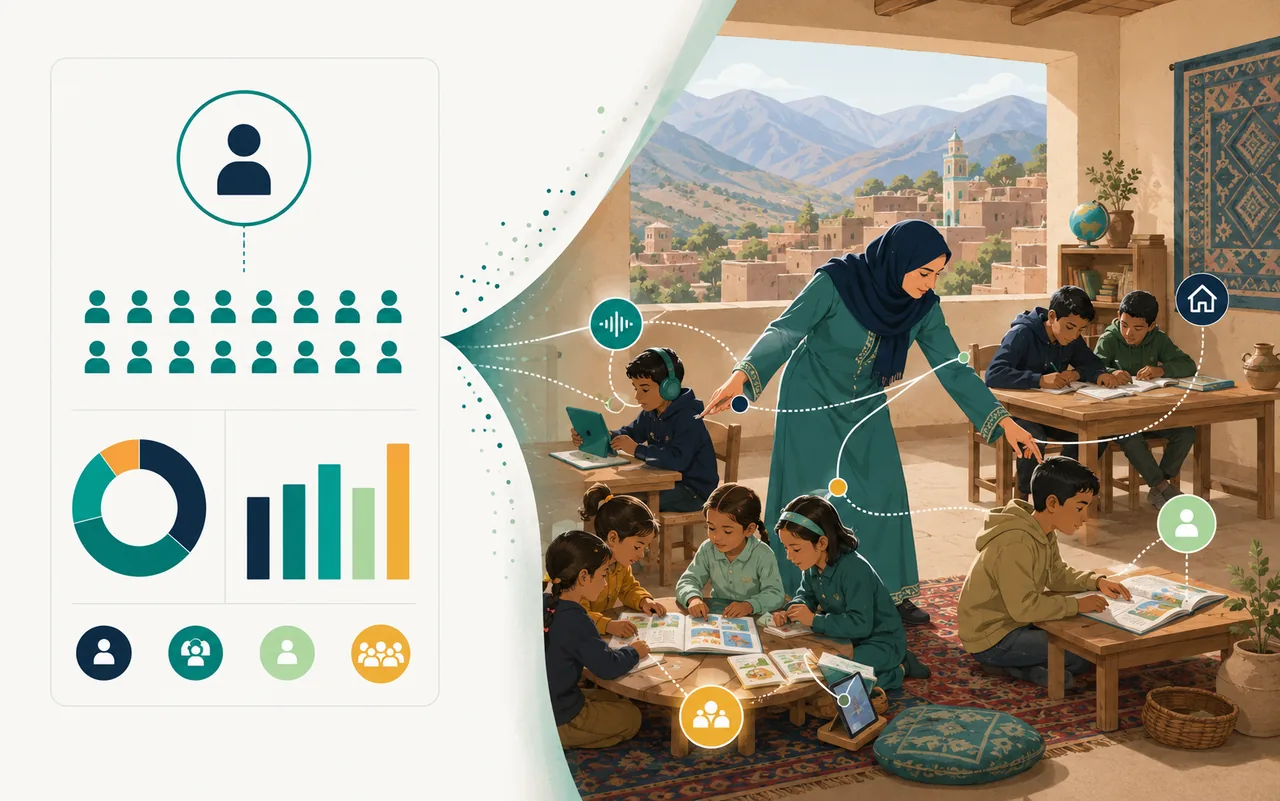
One commonly used proxy for teacher scarcity is the presence of multigrade classrooms, where a single professional instructs students across multiple grade levels and often across different subjects.
In Morocco, national education discourse acknowledges that multigrade teaching remains common in rural communities as an operational response to limited staffing and challenging geography. Educators in these settings must juggle varied curricula with limited support.
Multigrade classrooms are well documented in education research as a sign of thin staffing density rather than a pedagogical choice in well-resourced systems.
Teacher Quality and the Challenge of Support
The global teacher shortage discussion also points to attrition as a driver of persistent gaps. According to UNESCO reporting, the annual attrition rate for primary teachers worldwide nearly doubled between 2015 and 2022.
Retention challenges are especially important in rural communities, where isolation, limited housing and amenities, and fewer professional support networks can make it harder to keep qualified teachers in place.
What the Data Suggests
- Teacher shortages are large in absolute global terms, with an estimated need of 44 million additional educators by 2030.
- Attrition and distribution challenges compound the shortfall.
- Rural areas are often least able to attract or retain qualified teachers.
- Morocco's rural teacher data points to structural inequalities that are not fully captured by simple pupil-teacher ratios alone.
Taken together, these findings align with what many community members and educators observe on the ground in rural settings: access to consistent, qualified instruction is uneven, and for many learners outside major cities, educational capacity remains constrained.

Why EdTech Matters in This Context
Where teacher availability is limited, educational technologies that expand instructional reach, offer consistent individualized support, and enable practice beyond class hours can complement existing systems.
In contexts like rural Morocco and many other regions worldwide, technology is not a replacement for teachers. It is a capacity expansion tool that can help fill gaps that currently limit learning opportunities.
References and source material
- UNESCO Global Report on Teachers.
- UN News reporting on teacher shortages.
- World Bank SABER Teachers: Morocco Country Report.
- World Bank research on teacher distribution inequities.
- World Bank research on multigrade teaching.
- Education Week reporting on global teacher attrition.
Written by
Founder perspective
Co-Founder & CEO
Thore Weber
Thore is building Dr. Read to make the kind of patient, one-on-one reading support that helped him become a confident reader available to every reader and family who needs it.